Fragmented Intelligence
Indicators and supporting evidence are distributed across multiple platforms.
MANTIS brings threat knowledge, continuous intelligence monitoring, YARA workflows, malware analysis, and evidence-aware AI into a single workspace built for security researchers.
Investigating a threat often means moving between knowledge bases, ransomware feeds, malware repositories, YARA tools, disassemblers, and reporting workflows.
Indicators and supporting evidence are distributed across multiple platforms.
Researchers repeatedly switch tools to research actors, monitor ransomware, compare samples, and validate YARA rules.
Connecting actors, malware, samples, rules, and threat activity requires additional analysis and correlation.
MANTIS brings these workflows together.
Move from threat knowledge and live monitoring into rule development, malware comparison, and structured binary analysis without leaving the investigation workspace.
Research known threat actors, activity clusters, malware families, and security tooling using MISP Galaxy, Malpedia, Microsoft, Tidal, and Kaspersky TIP context.
Track recent victims, groups, trends, affected sectors, ransom notes, cryptocurrency addresses, IOCs, and watchlist matches.
Search local and synchronized rules, scan samples, and move into a dedicated workbench for rule authoring and testing.
Compare samples using strings, imports, functions, basic blocks, and optional IDA or Hex-Rays features to support manual clustering.
Analyze PE, ELF, Mach-O, and .NET samples with supported IDA Pro or Ghidra workflows, then create Markdown, HTML, and PDF reports or portable AI workspace bundles.
Write, validate, test, explain, and safely refine YARA rules against files, paths, uploaded samples, or local corpora.
Collect daily intelligence and emerging signals from articles, vulnerabilities, X, and Telegram—then use MANTIS AI to organize evidence and communicate findings.
Review a consolidated daily view of CTI articles, exploited vulnerabilities, new PoCs, ransomware activity, regional signals, and social intelligence.
Build a searchable local article library from synchronized RSS feeds, preserved metadata, extracted indicators, and MANTIS AI summaries.
Track PoC availability, trending exploit repositories, CISA KEV entries, severity and references, plus malicious-package intelligence from OSV.
Follow configured researchers and CTI accounts for early vulnerability, PoC, malware, campaign, infrastructure, and actor signals.
Monitor authenticated channels, collect messages, and surface IOCs, credentials, archives, victim mentions, and target artifacts for investigation.
Work over collected evidence to summarize findings, connect relationships, guide passive pivots, assess attribution evidence, and draft investigation reports.
Each project solves a valuable part of the threat-intelligence workflow. MANTIS is differentiated by bringing collection, investigation, malware workbenches, and evidence-aware reporting together in a single analyst-focused environment.
| Project | Primary focus | IOC & OSINT enrichment | CTI knowledge | Continuous monitoring | YARA & malware analysis | Social / Telegram | AI & reporting |
|---|---|---|---|---|---|---|---|
| MANTISThis project | Unified analyst workbench | ✓ | ✓ | ✓ | ✓ | ✓ | ✓ |
| IntelOwl | IOC and file enrichment | ✓ | ◐ | ◐ | ✓ | — | ◐ |
| OpenCTI | STIX knowledge graph | ◐ | ✓ | ◐ | — | ◐ | ◐ |
| MISP | Intelligence sharing | ✓ | ✓ | ✓ | ◐ | ◐ | ◐ |
| YETI | CTI and DFIR enrichment | ✓ | ✓ | ◐ | ◐ | — | — |
| SpiderFoot | OSINT and attack-surface mapping | ✓ | ◐ | ◐ | — | ◐ | — |
| OpenOSINT | AI-assisted passive OSINT | ✓ | ◐ | — | — | ◐ | ✓ |
| Watcher | AI-powered CTI monitoring | ◐ | ◐ | ✓ | — | — | ✓ |
Based on publicly documented open-source capabilities as of November 2026. Integrations and available features may change.
MANTIS combines IOC enrichment, threat knowledge, daily intelligence, ransomware, vulnerability, X, and Telegram monitoring in one local workspace.
YARA authoring and testing, sample similarity, and IDA or Ghidra-backed binary analysis are first-class workflows rather than external handoffs.
MANTIS AI works over collected evidence and supports daily briefs, investigation reports, and Binary Lab output in Markdown, HTML, PDF, and portable workspace bundles.
Start with a single indicator and follow the evidence through enrichment, discovery, pivoting, and analysis.
Collect intelligence from configured sources.
Normalize and correlate collected information.
Identify related indicators, infrastructure, and artifacts.
Expand the investigation using supporting evidence.
Review relationships and generate findings.
Export findings for analysis or reporting.
Explore the actual MANTIS knowledge, daily intelligence, CTI, vulnerability, social-monitoring, evidence-aware AI, YARA, similarity, and binary-reporting interfaces.
Search known actors and activity clusters, review aliases and references, and pivot names back into MANTIS investigations.
Monitor victims, groups, regional and sector trends, ransom notes, cryptocurrency addresses, IOCs, and watchlist activity.
Bring CTI articles, vulnerability activity, PoCs, ransomware, regional events, and social signals into one daily operational view.
Prioritize vulnerabilities using public PoCs, trending exploit repositories, CISA KEV context, severity, references, and OSV package intelligence.
Monitor authenticated channels and review collected messages for IOCs, credentials, archives, victim mentions, target references, and investigation artifacts.
Summarize collected evidence, examine relationships, guide passive pivots, and produce structured intelligence reporting while keeping source context visible.
Write, validate, test, explain, and save YARA rules through supported local workflows.
Compare new samples with defined malware or threat-actor entities and inspect shared static characteristics.
Review AI-assisted malware findings and generate Markdown notes, interactive HTML, downloadable PDF reports, or portable AI workspace bundles.
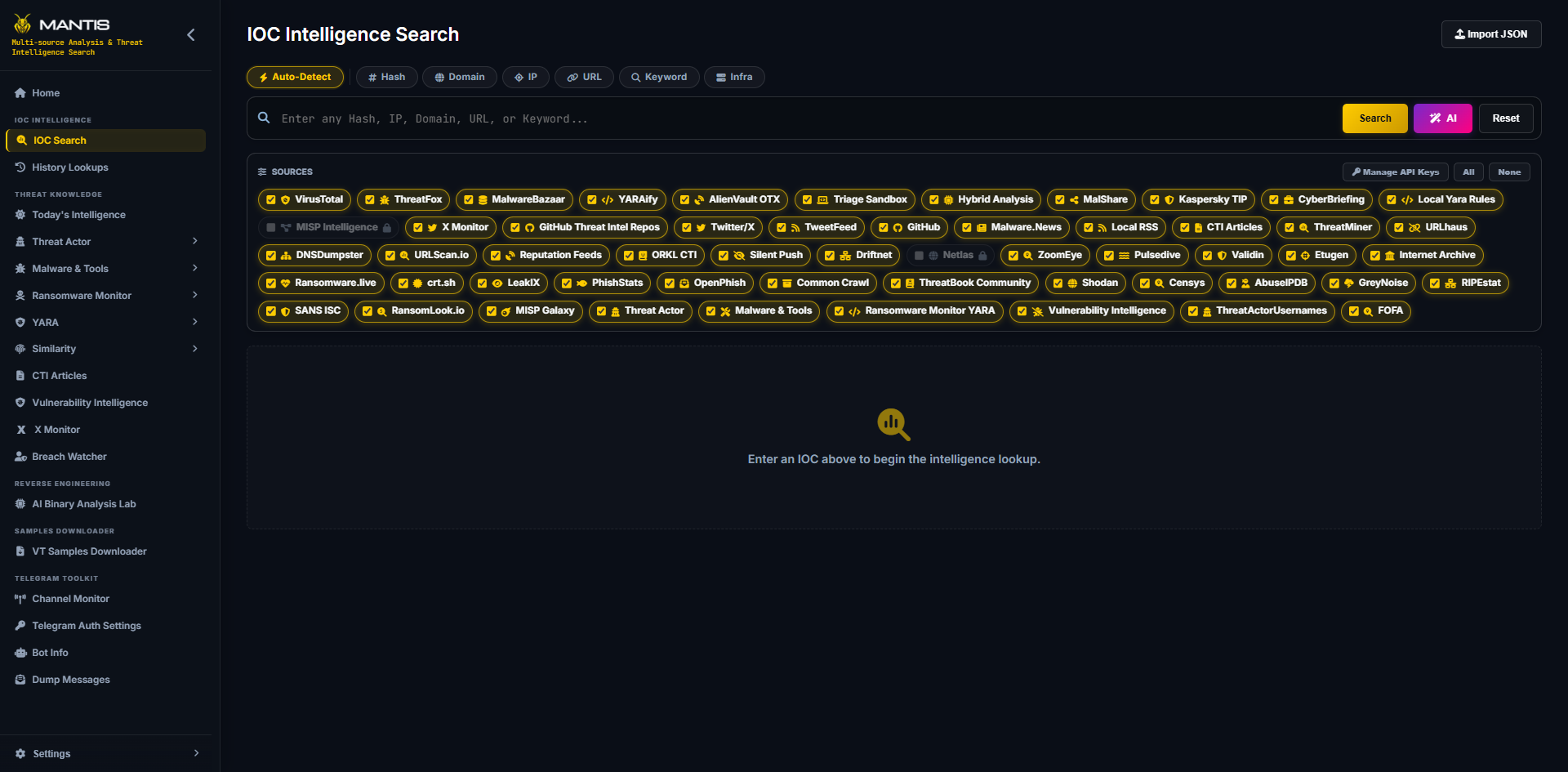
Combine built-in local datasets, keyless public lookups, and optional API-backed intelligence providers.
Integrations may require individual API keys, subscriptions, or external services.
 Censys
 Common Crawl
 CTI Articles
 CyberBriefing
 DNSDumpster
 Driftnet
 Etugen
 FOFA
 GitHubGitHub CodeGitHub Threat Intel Repos
 GreyNoise
 Hybrid Analysis
 Internet Archive
 LeakIXLocal RSSLocal YARA RulesMalware & Tools
 Malware.News
 MalwareBazaar
 MISP GalaxyMISP Intelligence
 NetlasOpenPhish
 ORKL CTI
 PhishStats
 Pulsedive
 RansomLook.ioRansomware Monitor YARA
 Ransomware.liveReputation Feeds
 RIPEstat
 SANS ISC
 Shodan
 Silent PushThreat Actor
 ThreatBook Community
 ThreatFoxThreatMinerTriage Sandbox
 TweetFeedTwitterTwitter/X
 URLhaus
 URLScan.ioValidin
 VirusTotalVulnerability IntelligenceX Monitor
 YARAify
 ZoomEye
Provider marks and site icons identify external services. The MANTIS badge identifies local workbenches; a neutral source mark is used where no reusable provider icon is available.
MANTIS runs as a locally hosted application and stores core investigation artifacts in local databases and files. When you enable external intelligence or AI providers, relevant queries and context are sent to those configured services.
External communication occurs only for configured provider lookups, collection tools, or AI services—not every MANTIS workflow is offline.
MANTIS recommends Python 3.10 or newer and a modern browser. Optional analysis and monitoring features may require their own native tools or credentials.
Read complete installation documentationrun.batStarts FastAPI at http://127.0.0.1:9999 by default.
chmod +x start_linux.sh
./start_linux.sh
Starts the backend on port 8000 and frontend on port 8080.
MANTIS is an open-source project designed to support practical threat intelligence investigations and security research.
Explore the source code, set up your investigation environment, and start connecting intelligence across multiple sources.